Showing posts with label dentists. Show all posts

Thursday, March 21, 2013

When drilling on a tooth, how do you know where the cavity ends?

Long question, but it is one that we get all the time. Here is a step by step view of drilling out a cavity.

Tooth BEFORE Drilling Out Cavity
This is a tooth prior to being worked on. There are no upon visual inspection. The cavity was located with x-ray.

Drilling Out Cavity - Step 1
As we drill into the tooth, we can see 2 things. First, we see the yellowish color of healthy tooth. We know not continue drilling at that location. Second, we see the extreme white of a demineralizing tooth (cavity). We know to keep drilling at that location.

Drilling Out Cavity - Step 2
Here, we see that the white color is gone. This lets us know that we have reached the end of the cavity and have completed the drilling sequence of the procedure.

Tooth AFTER Drilling Out Cavity
Here is the tooth in its final state. All the cavity is gone and the final filling is placed. And while the tooth is not “as good as new”, nothing ever can be. It is as close as we can come to it.


Dr. Jim Ellis, DDS
1220 33rd Street Suite C
Ogden, UT 84403
(801) 783-3490


SOURCE: http://www.bestogdendentist.com/2013/03/when-drilling-tooth-how-do-you-know-where-cavity-ends/

Wednesday, March 20, 2013

Quality Care hurt by Big Business more than Big Government

Dentistry is different from most other health care. Dentists can still run their own mom and pop shops. You can’t find any medical doctors that can do that anymore. They are all beholden to insurance companies. More so then government changes, it is this type of over reaching corporate changes that are effecting the field of dentistry. In fact within 10 years, 40% of dentistry will be corporate dentistry.

Companies that just hire dentists as employees rather then the dentist running the show. The companies will be able to buy supplies in bulk and cut overhead thereby cutting the price. Good for pocketbook of patient but bad for care. Those dentists are required to be in and out of rooms and done with procedures in certain time frames. No chit chat. If you are scared and need more time and TLC you will be out of luck.


Dr. Jim Ellis, DDS
1220 33rd Street Suite C
Ogden, UT 84403
(801) 783-3490


SOURCE: http://www.bestogdendentist.com/2013/03/quality-care-hurt-big-business-more-than-big-government/

Friday, February 1, 2013

Is having more or less Saliva important?

In two words, OH, YA!

Saliva is critical to the health of your teeth and gums. Without it, there would be serious ramifications.

Saliva is produced from 3 major glands in your mouth -- Parotid gland, Submandibular gland, and Sublingual gland.

Human Salivary Glands Diagram

And, it plays two major roles in the body:
  1. Saliva helps to lubricate food before it goes down your throat so that harder foods will not damage your insides on the way to the stomach.
  2. Saliva helps to wash harmful sugars and bacteria off of you teeth.
One of the most damaging things to your teeth is a dry mouth. Dry teeth will soon be dead teeth. A dry mouth can be caused by a number of things. The largest cause of dry mouth that I see is from medications. Specifically heart regulating and mood altering medications have the greatest effect but it can be any medication.

Dry mouth can also be brought on by age. Just as your eyes aren't as moist as they used to be, so to may your mouth begin to dry out over time.

If you feel like your mouth is drier than it used to be, please contact your dentist right away. There are things you can do to help.


Dr. Jim Ellis, DDS
1220 33rd Street Suite C
Ogden, UT 84403
(801) 783-3490


SOURCE: http://www.bestogdendentist.com/2013/01/having-more-less-saliva-important/

Tuesday, January 15, 2013

Tooth Discoloration (Before & After)

Teeth can discolor for many reasons. Most everyone will experience a general discoloration of their teeth as they age. This is normal. And, there are many ways by which this situation can be remedied.
There can also be discoloration of only one tooth. This is much less common then the generalized discoloration but is still fairly common in its own right. This is typically due to trauma, with or without a root canal. A tooth that has suffered blunt force trauma may turn color.

The picture below is an example. This tooth suffered trauma and then needed a root canal. The tooth turned very dark and the patient wanted it changed.

Ogden Dentist BEFORE: Tooth Discoloration

The after picture is simply the temporary crown. The final crowns will look even better.

 Ogden Dentist AFTER: Tooth Discoloration


Dr. Jim Ellis, DDS
1220 33rd Street Suite C
Ogden, UT 84403
(801) 783-3490


SOURCE: http://www.bestogdendentist.com/2013/01/tooth-discoloration-before-after/

Tuesday, June 5, 2012

Step by step pictures of getting a filling.

Okay, her we go. 
Step one, the tooth below had a cavity that was in between it and 
the tooth that sits above it in the picture.
Please take a moment to note that you can not see the cavity with your eyes.
We found it on an x-ray. That is why waiting to come to the dentist till
after you can see the cavity is a bad idea. By then it is much bigger
then it otherwise needed to be. 


Step 2, cut away the portion of the tooth that is bad.


Step 3, separate the 2 teeth so that the filling material 
only sticks to the tooth we want it to.
The filling material will now be placed into the hole in the tooth.


Step 4, once the filling material is placed in the tooth we 
shape it and contour it so that it blends right in with the tooth.
The goal here is that the filling is not visible.
On a picture this big you can barely see the edges but just 
looking into someones mouth seeing this filling would be next to impossible.

Now next time you need to get a filling you will know what is happening.


Thursday, May 31, 2012

How do you tell someone they are old?


Almost everyday I have to tell someone, that has
never had a cavity, that they have a cavity.

Many of these people are in the 50's or 60's.

They spend lots of time brushing and flossing and have never had a
cavity and don't understand how they now are getting cavities when
they are doing the same things that they have always done to keep their teeth clean.

At this point I have to be very diplomatic.

The simple answer is...... you are getting older.

As we age things will begin to break down.

These people have no problem accepting that their eyesight isn't what is used to be.
Or that their hearing may be a little worse then it was when they were younger.
But for some reason, the fact that their teeth are also wearing down is a new concept.

Every part of our bodies will break down over time.
Teeth will follow right along with the rest of it.

The forces of a lifetime of chewing mixed in with the fact that salivary flow
rates decrease as we age (thus less protection for our teeth) means that
an increase in cavities over time is almost inevitable.


Thursday, May 3, 2012


There are lots of myths out there.
The Lochness Monster, Bigfoot, etc.etc.

Mine is the myth of the cosmetic dentist.

There is no such thing as a cosmetic dentist.

Here is a list of the specialties that are recognized by the ADA. Orthodontics and Dentofacial Orthopedics, Endodontics, Dental Public Health, Oral and Maxillofacial Pathology, Oral and Maxillofacial Radiology, Oral and Maxillofacial Surgery, Pediatric Dentistry, Periodontics, and Prosthodontics.
Each one of these specialties is strictly regulated. Each doctor that practices in one of these fields must go through advanced licensure requirements and advanced schooling even beyond dental school. These doctors carry with them advanced knowledge that is strictly regulated by the ADA.
If you noticed none of those specialties that I just mentioned was called the specialty of cosmetic dentistry. That's because it doesn't exist. And as a matter of fact it is illegal to advertise yourself as a cosmetic dentist.
The idea of being "cosmetic" simply means that you try to make things look better. Well, there isn't a dentist, or specialist, out there who DOESN'T do this. Everyone in the dental field has the goal to make things look better. Its what we do.
Now, is it true that a dental professional can go to courses, after dental school, that focus solely on cosmetic procedures? Absolutely. And I have been to many of them. But that does not mean that I am a specialist in cosmetic dentistry. Because, once again, no one can be. It doesn't exist.
If you have things that you would like to see changed about your teeth then ask around. Find a dentist that has a good reputation for that kind of thing. Then when you meet him/her ask to see some of their work. If it looks good then you are probably at the right place.

Here is a case that we did in our office.
Before

After


Wednesday, May 2, 2012

I have too many missing teeth for you to fix.

Sometimes folks come into the office and tell me that their teeth
are so bad and that they have so many missing ones that there
is no way that I could possibly fix all of them.

Well almost 100% of the time they are wrong.

Take Jenny for instance. 
Jenny had several missing teeth all on the same side.
She thought there was nothing that could be done.

Below you will see a picture of a bridge that we made for jenny.
This bridge goes from her very back tooth all the way up to
one of her front four teeth.
(Sorry its a tad blurry)


Its all one piece.
It will get cemented in place and won't need 
to be removed on a nightly basis.
It looks fantastic.
And its a way to replace 3 of Jenny's missing teeth at one time.


Monday, April 16, 2012

I don't have dental insurance.


Just going to get up on a little dental soap box for a second.

I have people come into my office all the time with a really bad toothache.
I ask these folks why it is that they didn't come in sooner.
The answer that I get, a lot of the time, is that they didn't have dental insurance.

Now, this answer does have its merits.
Dental insurance does in deed help with the cost of dental care.

However, there is another side the story.

Say you have a small cavity.
This cavity would cost, lets say, $100 to fix.
If you let that small cavity go however, you may need a root canal.
A root canal would cost about $500.
If you needed a crown after the root canal then we need to add another $800.

So what would have cost you $100 will now cost you $1,300.
You still have no insurance but now you do not have a choice to
fix the problem because it is killing you.

The far better solution would be to come in and get the
problem fixed when it is small.

Financial arrangements can easily be made to accommodate anyone
who may be struggling to come up with the funds.

Save time, money, pain, and multiple trips to the dental office.
If there is a problem PLEASE do not put it off.

Your teeth and your wallet will thank you.


Wednesday, April 11, 2012

What are dental sealants?


A sealant is a protective covering that is placed over a tooth
so that it is harder for the bacteria to attack it and cause a cavity.
Material is flowed into all of the cracks and grooves to protect
them and then the material is cured to a hard state.
99% of the time the teeth that are
sealed are the 1st and 2nd adult molars.

These teeth come in at ages 6 and 12 respectively.

Any tooth can be sealed but it is typically these two teeth
because they are the most likely to get cavities and they
are the ones the the insurance companies will pay for.

You children don't need sealants but it sure does help.
Adults can get sealants on their back teeth but you will pay for it all yourself.

If you are interested, talk to your dentist.


Tuesday, April 10, 2012

How long until my tooth breaks?

This question is one that we get, probably, more often then any other.

Below is a picture from a patient that we saw for the 
first time yesterday. You will notice that towards the
top of the picture there is a chip out of the tooth.

The tooth has a large metal filling already and is in a weakened state.

How long this tooth will last till it suffers a more significant break is 
almost completely up to the patient.

If the patient went on an all yogurt diet then the tooth would last a long time.
If the patient had a corn-nut addiction it may last 12 hours.
There is really no way to tell.

Best thing to do is obviously to get it fixed.
But if you can't then the best thing is to make sure that you 
don't chomp down on anything really hard on the side until
you can get it fixed.


Friday, April 6, 2012

Can you even fix this?

Its funny what people will say sometimes.
This patient wasn't even sure that we could fix his tooth, at all!
Well, this tooth, and so many more like it, are 
very much savable with just a little help from your
friendly neighborhood Ogden Dentist.

Here is the before picture.
This patient needed work on the tooth in the middle of
the picture and the tooth on the right side of the picture.


We finished this up in about 40 minutes.
Both teeth required the use of filling material but neither
tooth needed to be numbed up at all.

Patient chose a lighter shade because the next 
step is to bleach the teeth.


Tuesday, April 3, 2012

There is always on option.

Our patient had a tough decision on her hands.
She lost her side, front tooth. 
She wasn't a good candidate for implants so that was out.
She also had a bridge that already included her front teeth.
So what to do.

Fuzzy (sorry) picture of the missing tooth and the canine
tooth that we will be using.
The canine tooth has already been prepared so it 
appears a little shorter then it normally would.

Here are the new crowns that will soon be placed in the 
patient's mouth.
The crown is going to go over the canine and the other
tooth is just hanging off of the canine crown.

Here are the crowns in place.
So we were able to save the front teeth crowns and
still manage to replace her missing tooth without
doing an implant.


Tuesday, March 27, 2012

What is a tooth abscess?

When a tooth goes bad it will begin to produce infection.
That infection wants to go somewhere.
In a typical tooth the only way out of the tooth is out the 
end of the tooth into the bone.
Once the infection is in the bone it then wants to find a way out of that.
After making it though the bone it will then try to make its way though the gums.
It is at this point when you will start to see the redness, swelling, and 
drainage that are signs of an abscess. 

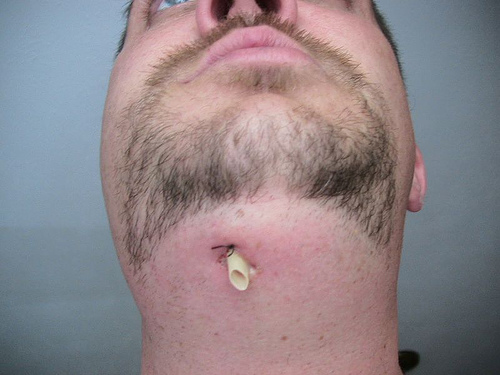
Abscess' can come in different forms and in different places.


Here is an abscess at the top of the front tooth.
This one is very red and inflamed. 

Here is an abscess that came out the bottom of the chin.
What you are seeing is a plastic drain that has been inserted to
take away any extra infection.

Here is an abscess at the top of a rear tooth.
This abscess is white and doesn't look very inflamed.


Thursday, March 15, 2012

Now you see it......

Patient came in yesterday with a cavity in her front tooth.
This would normally be kind of annoying but in 
her case it was an even bigger problem.
She is getting bridal pictures taken in just a few weeks!

Here is the before picture.

Here is the after picture.

We were able to do this in about 30 minutes, 
and we didn't even need to get her numbed up.

Good luck with the wedding!!


Tuesday, March 13, 2012


Lets see if this is you.
Your tooth hurts, but only sometimes.
Its not sensitive to changes in temperature.
It hurts to bite on things but only every once in a while.
You have asked your dentist but they can't find anything wrong with it.
Any of this sound familiar?

You may have a cracked tooth.


Cracks are not always visible by the dentist.
It takes some time and investigation to find them.
Once found however, depending on the severity of the crack, they can be fairly easy to fix.

So if you find yourself having random tooth pain that is driving you crazy, consult your dentist about whether or not your tooth could be cracked.

Dr. Ellis on Facebook

Dr. Ellis Website

Dr. Ellis on Google+

Monday, March 12, 2012

The Floss Replacement?


Houston, we have a problem.

No one likes to floss.
Some people do it but even those folks don't find it to be the highlight of their day.

Floss manufacturers know this and so they have been coming out with floss alternatives to try to entice people.

One of these alternatives that is really catching on is a little thing that looks like a piece of pipe cleaner. You take this little pipe cleaner job and push it back and forth at the base of you tooth.

These things are called inter proximal brushes, proxi brushes, etc. But they all do the same thing.

Here are some examples.
So what's the problem?

The problem is that although they do a great job of getting things out from the space right above the gum line, they absolutely do not get to the most important spot in between the teeth.

This most important spot is the spot where the floss snaps.
That spot that snaps is where the bugs that cause the cavities are hiding.
They wedge into the hardest spot to get to in order to cause cavities.
If you do not feel that snap then you are not getting that spot clean.

Don't get me wrong here.
I love it when people use the little pip cleaner jobs.
However, I am starting to see more and more folks that are getting cavities that say to me, "how is that possible?! I am using those pipe cleaners all the time."

Use these cool new gadgets just don't let them replace the floss.


Friday, March 9, 2012

Implant continued.

We were back with our good buddy Collinn today.
I changed the spelling of his name to protect his innocence. 

Collinn had a root canal that failed (not mine :) )
The dark area at the end of the tooth denotes infection 
originating from the failing root canal.

This is the site after the extraction occurred. 
The area was also cleaned of infection 
and a bone graft was placed.

Here is a picture of the implant that was placed 
about 4 weeks after the extraction took place. 
the top of the implant is right at the bone level
and the infected area looks to be healing nicely.


After 6 weeks (this morning) the abutment (top of the implant) was placed.
This part is what what the new crown will sit on.


 Things are going swimmingly.
Within 2 weeks we will have the final crown in place
and Collinn will be back to is good old self.


Thursday, March 8, 2012

What's on the inside of my tooth?

Your teeth are hollow.
The hollow chamber contains the blood vessels 
and nerves that give your teeth, life.

A root canal is simply the process of accessing this
chamber and scrubbing it clean of all its contents
so that it can't cause you anymore pain.

This is the inside of a molar. 
We were almost completed with a root canal when
I decided to snap this picture.

Since this is an upper molar it has 3 roots on it.
Typically each root has one canal in it.

After the inside has been scrubbed clean the
canals are then filled with a rubberized material.

The hole we make to access the nerve chamber is then
filled with a typical filling material used to fill cavities.


The pink stuff you can see inside the tooth
is the rubberized material that has already
been placed down into the canals.


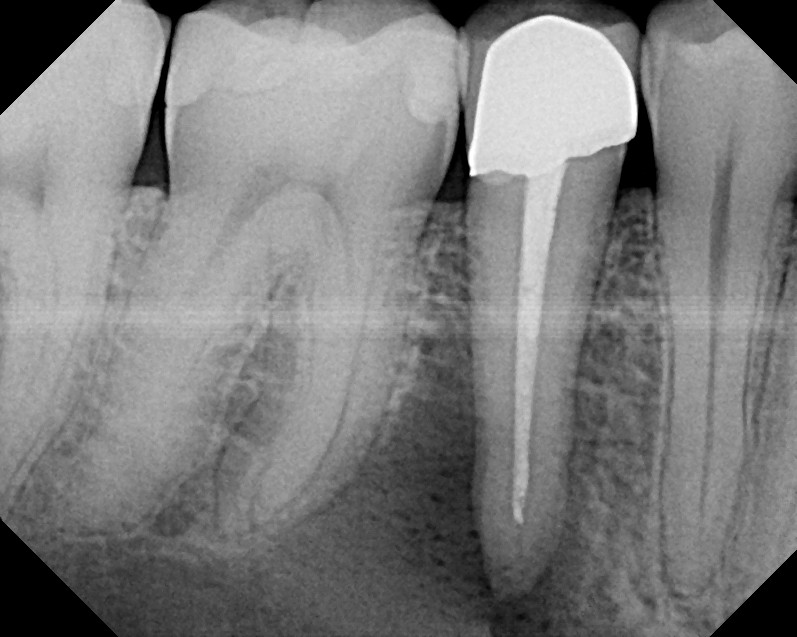
Here is a X-Ray of the molar before we worked on it.
Notice in the teeth that there is a black line down the center, 
that is the hollow space where the nerves reside.

Now instead of black lines you can see white lines.
Those white lines are the rubberized material.
If all goes well this tooth will no longer cause the patient any more trouble.