Showing posts with label infection. Show all posts

Monday, June 24, 2013

What a drain in the neck!

What a drain in the neck!  What is going on in this picture? 

Well I will tell you. The patient had a tooth that went bad. The tooth started to produce infection. The infection needed some place to go. Typically the infection will produce a bump (abscess) on the gums. In this case however the infection decided it would work its way out the bottom of his neck. What you are looking at is a small piece of rubber tubing that is stitched into and incision in the patient's neck. This is what is termed in the medical community as a drain. This drain is attempting to allow all of the infection in this mans mouth and neck come out. This is definitely a rare case but it can happen. Do NOT let things get out of hand with your teeth. 

Last thing you want is someone saying, "So what is that thing in your neck?"  


Wednesday, February 29, 2012

Want to replace those metal fillings?

Here are before and after pictures of a patient that
wanted to get their metal fillings replaced.

This before picture is a little foggy but you can still
see the stark color contrast between the color of
the metal filling and the natural white of the tooth.

This color contrast is what makes most people want to change 
out their fillings for white fillings.


Here is a picture of the tooth after we took out the metal and 
replaced it with a white composite filling.

Even this close you can just barely make out the transition line
between the filling and the natural tooth.
In real life no one would ever be able to tell that you had a filling at all.


This procedure is quick and fairly inexpensive when compared to
getting crown or other expensive restorations placed.


Tuesday, February 28, 2012

My canine teeth are too pointy! What can be done?


Canines are unlike any other teeth in the mouth.
Every other tooth in the mouth is, almost, a copy of a another
tooth in the same corner of the mouth.
You have 2 incisors, 2 pre-molars, and 2 molars per quadrant but only 1 canine.
These teeth are also, typically, the longest rooted teeth in the mouth.

One problem that people have with their canines is that sometimes
they feel as if they are a bit too pointed.


They hide them when they smile for fear that they look too much like a vampire.

Well there has never been an easier fix for just about anything.

All you need to do is file those bad boys down just a bit.
You do not need to be numbed up and it will only take a moment to do.
You will have less enamel so the chances that you could get decay in the
future are slightly higher. But, with a little added attention to your home
care that should never end up being a problem.


Monday, February 27, 2012

Give me some of that gas!

So what is laughing gas?
Why do we use it?
Is it okay for anyone to have? 


Technically speaking laughing gas is Nitrous Oxide or N20. 
Here is a nice little diagram of its chemical make-up.


We use laughing gas to take the "edge" off.
When someone is nervous about a situation then any little stimulus will
seem a bigger then it actually is.
This is true for the dentist office as well.
Routine procedures can become overwhelming to dental phobic patients.
We therefore administer gas to remove that overly tense feel and 
make the routine seem routine again.
The effect of the gas creates a slightly euphoric state in people. 
Feelings of floating or tingling all over are very common.
But most of all it just makes you more relaxed. 

It is a very safe product to use and unless you have some sort of respiratory 
problem almost anyone can safely use it.

To tell you what exactly it does would sound something like this.......

 "It seems N2O-induced release of endogenous opioids causes 
disinhibition of brain stem noradrenergic neurons, 
which release norepinephrine into the spinal cord and inhibit pain signaling."

But since most people have no idea what that means just trust me when I tell you
that it works, its safe, and you feel much better for having it : )


Thursday, February 23, 2012

Which electric toothbrush is better?


Okay, because you asked.
When the topic of electric toothbrushes comes up there are two big questions that I always get asked.

Questions.

#1 Do I need one.

#2 Which one is the best.
Answers

#1 No. You do not need an electric tooth brush. If you are a diligent brusher then it does not really matter if your tooth brush uses batteries for power or uses you for power. The results can be the same. This is not to say that the results will be the same in the same amount of time. Because they wont. The manual tooth brush will take a little longer but it is capable of doing the same thing.

# 2 This question is like asking which car is the best. Well, a Ferrari is the fastest and looks the best, but a Toyota Camry will do you just fine. The same is true for tooth brushes. There are tooth brushes out there that can run you over $300. They have timers to tell you when to stop. they will talk to you and tell you to switch sides of the mouth. They have pressure sensors to tell you if you are brushing too hard. And they look really cool. However, the electric toothbrushes that cost $10 can do just as much for cleaning your teeth. The whole idea behind cleaning your teeth is just to get the bristles to remove the plaque. Little timers are nice but if you are capable of getting your teeth clean without a timer then what is the point.

So what do I use?

I use an Oral B electric. I like the way it feels when it cleans and it seems to work well for me. My wife uses a Sonicare, and can't stand my Oral B. Conversely I have used her Sonicare and that thing drives me up the wall. So there is a lot to be said here about personal preference.


Tuesday, February 21, 2012

Does Grandpa have loose dentures?


It happens all the time.
Grandpa/Grandma/You have a top denture that fits
great but the lower denture is awful.
There is help.
2 implants need to be placed in the lower jaw.
Each one of those implants will have a gold housing on top of it.
These housings have undercuts in them that will serve as retention for the denture.
The old denture then gets holes drilled into it and metal
receptors with o-rings place in the holes.


These receptors with the o-rings will fit down over the implant housings and
secure the denture to the jaw.

It works very well and people are very happy that their denture is
no longer floating around in their mouth.


Monday, February 20, 2012

Do you have bad breath?


What is the cause of bad breath??

There are many causes.
Teeth that are decayed.
Gum disease.
Bacteria.
Digestion problems.
Etc.

One of the first things to do in order to determine the cause of your
bad breath is to get to a dentist and get a good cleaning.
This will make sure you start off with a clean slate.

Then.....
For 2 weeks commit to brushing after each meal.
For 2 weeks commit to flossing daily.
And for 2 weeks commit to rinsing with a mouthwash such as Listerine, daily.
(Important note: You also need to brush your tongue.
Tongue scrapers, pictured below, are also available.)
After the 2 week period see how your breath is.
If it still smells as fresh and clean as it did when you left the dentist office
then your bad breath was, more then likely, a result of poor oral care.

This would be good news because all you need to do is continue
your new pattern of brushing, flossing, and rinsing and your bad breath should be history.

If things return to there normal, bad breath, state then other things need to be considered.


Monday, January 30, 2012

Dentists and The Movies.

Why is it that in any movie where there is a dentist,
or something related to dentistry, that its bad.

I mean come on.... I'm a nice guy : )

Probably most famous would be 
Little Shop of Horrors


Another one is the seen from 
Finding Nemo
where the guy is screaming during his root canal.

Another is 
Cast Away
who can forget that poor guy knocking his 
abscessed tooth out with an ice stake.

Lets hear your favorite dental movie moment.


Thursday, January 26, 2012

 Okay. So my tooth had this HUGE metal filling in it. 
Well, now most of what was left of the tooth broke off.
What now?!

Well there are a couple of options.
One of the best options to to do an implant.
There are a number of reasons for this but that
would take more time then we have right now.
First step is to extract the broken tooth. 
In this case we placed a bone graft and waited a few weeks 
but that doesn't always have to be the case.


After the healing time we place a titanium implant.
Looks scary? 
It's not.
It's basically just an artificial tooth.
If we can replace hearts and hips then why not a tooth?

O

In about 6 weeks we will put a beautiful white (no metal)
crown on this implant and the patient should have no more troubles.


Monday, January 23, 2012

Mr C. came to our office one day with a failing root canal.
Like other medical procedures, root canals can fail.
After weighing the options Mr C. decided to have
 the tooth extracted and an implant placed. 

(Before the extraction.) 
Showing the root canal and a pretty decent sized infection.
Tooth was extracted and a bone graft was placed in the site.
Waiting time will be about 3 weeks.

Day of the surgery went very well.
Head of the implant is flush with the bone so our aesthetics should look great.
Infection now gone and infected area even starting to fill in a little.
8 weeks from now we will have a beautiful new tooth on there.


Tuesday, January 17, 2012

Implant case

Here is as straight forward of an implant case as you will see.

Patient had a failing root canal on a pre-molar tooth.

Tooth was extracted and a single implant placed.

After healing had occurred then a solid zirconium crown was put in place.

Patient is very happy with the result.

Dr. Ellis on Facebook


Monday, January 16, 2012

I don't have any back teeth. What are my options?

Over the years many people, for one reason or another,
 have lost some of their back teeth (molars). 

What are the options to replace these teeth?

Some of the more common options are dentures and/or implants.

But there is another option that most people are not aware exists.

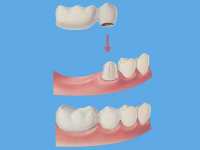
It is called a cantilever bridge.

What is a cantilever bridge you say?
Well, first we need to discuss what a cantilever is.
The pictures below illustrate cantilevers.
It is when something is stretched out into space without any support on one end.


So what does this have to do with dentistry?
Below you will see a picture of a cantilever bridge.
You can place a crown on your furthest back tooth and then hang
another crown off the back of that. 
The conditions have to be right for this to happen, but if they are
then it can work really well. 


Friday, January 13, 2012


There has been a large push in the media over this issue but we are still
seeing it in the office so I think it bears repeating.

Early childhood cavities are bad news.
These cavities are costly to fix, it is harder to keep them intact,
and drilling on children gives them a bad perception
of what going to the dentist is all about, which will stay with them
for a long long time and effect how they view dental care in the future.
Simple rule of thumb here.

Do not give your children anything to drink, that is not water, in between meals.
At meal time they can have lots of stuff.
Juice, milk, koolaid, etc.
After the meal is over have them brush their teeth or swish with a glass of water.
This will help clean the sugars out of their mouths that they got form the meal.

ANY other time you should be giving them water.
It is the child that is continuously exposed to sugars that will get the cavities.

And for the love of all that is good and holy do not, under any circumstances,
put your child to bed with a bottle of juice, milk, or anything else.


Monday, January 9, 2012

You may need an apicoectomy?


I may need a what!?

Okay, its not something you hear everyday but its something that can
be very helpful if you find your self with a failing root canal.

Root canals do not always work.
Just as a knee replacement or a back surgery may 
not always work, the same is true with a root canal.

So what can be done if a root canal you got is starting to hurt
and possibly become infected?

One option is called an apicoectomy.
This procedure is not for every instance.
Proximity to the sinus cavity and/or nerves 
may make this procedure impossible.

But if your tooth is a candidate then this is how it works.
Below is a picture of a tooth with an infection at the end
that has already had a root canal.


A small access to the root of the tooth is made 
by making a small incision into the gums and then the underlying bone.
The infected area and tip of the root is removed.
This will allow the root canal and tooth to remain intact 
while still removing the infection.
After the infection is removed the gum tissue is re-sealed and the healing can begin.
This procedure is very effective and does no further harm to the tooth.
This is especially important if the tooth was crowned after the root canal was finished.
.


Wednesday, January 4, 2012

GAG!


What is gagging?
Gagging is simply a defense mechanism that your body has to keep you from chocking.
Now this is typically a good thing. No one wants to get something down "the wrong pipe".
This however, can cause problems at the dentist office.
Having a bad gag reflex can make it almost impossible to get certain dental work done.
The picture below will show several items.
The soft palate is what we are interested in for this discussion.
When something touches the soft palate the bodies natural reaction will be
to close your throat off and prevent whatever it is that just touched the
soft palate from continuing down your throat and choking you to death.
Another spot where the gag reflex comes into play is tongue.
This can be a little more problematic then the soft palate gag reflex.
Not much will ever touch your soft palate but your tongue gets touched
all the time as you eat or whenever you go to the dentist.

Not much can be done for the soft palate gag reflex but there is help for the tongue.

Take your tooth brush and find the spot that makes you gag.
Start brushing your tongue at a spot that does not make you gag and
work your way toward that spot. Keep doing that day after day until you
can brush anywhere on your tongue without gagging.

Another trick would be to place a little bit of salt on your tongue, where it
makes you gag, before going to the dentist. That will, hopefully,
distract that spot long enough for you to get done what is you need done.


Tuesday, January 3, 2012

What does Meth do to your teeth? (WARNING, not pretty)


There is a drug out there known as Meth.
Its not good for a whole boat load of reasons.
But seeing as how I am a dentist I will focus on the dental problems.

The first problem is that Meth causes your salivary glands to stop producing spit.
This may not seem like a big thing, but it is.
Just imagine if your tear ducts stopped producing tears.
Your eyes would dry out in a big hurry.
Dry eyes would be painful and damage would begin to occur.
Same thing with teeth.
Dry teeth will end up being painful and damaged teeth.

(Early meth use)
The next problem is that Meth will make a person grind their teeth.
Scientists really aren't sure why but they have seen it enough to know that it happens.
Grinding of brittle dry teeth will cause fractures to begin happening.

(Moderate Meth use)
Finally Meth will cause people to just not care anymore.
And when you really don't care about your teeth you really don't
take care of them and you really don't care eat of drink anymore either.

The black spots on the gums are what's left of the teeth.
They have either rotted, been broken down to, the gums.

(Severe Meth use)