Thursday, June 19, 2014

Dental Tooth Implants

This is a great case to show. 
First of all it shows a before and after of an extraction then an implant.
But it also shows the longevity of an existing implant.

The before picture shows a failing root canal on the right.


The after picture shows the tooth extracted and an implant placed.
We were able to place a nice 10mm long and 4.7mm wide implant.

What both of these pictures also show is an older implant on the left.
This implant has already had the crown placed on it.
The bone levels show that although this implant was placed several
years ago that it continues to be very strong.

Implants are a fantastic way to deal with the loss of one,
or several, of your natural teeth.


Wednesday, June 18, 2014

Gum Recession Fix

Many people deal with gum recession. 
For some it is a mild irritation but for others 
it can be very painful and effect the way you eat.

The enamel (white stuff) that covers your teeth only
goes as for as the gum line. 
If/when the gum line ever moves away from the enamel 
then root surface of the tooth is exposed.
Root surface is mush more sensitive to hot, cold, sweet, sour, etc 
then any other part of the tooth.

Sensitivity toothpastes can help.
But those must be used for the rest of your life and
if they are discontinued the sensitivity can return almost immediately. 
Toothpastes will also not cover up the discoloration that
can occur with recession.

A more permanent fix is to get a filling placed where the gums
have moved away from the enamel.

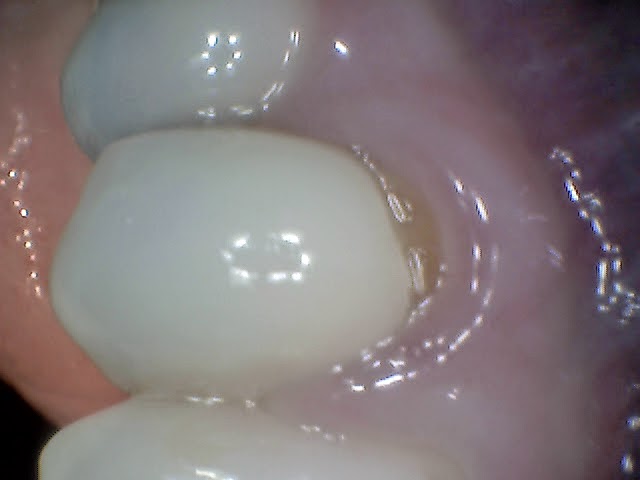
Here is a tooth experiencing recession.
The enamel is no longer going all the way to the gums.
The brown portion between the enamel and the gums
is the root structure.


Here we have the same tooth after a filling has been placed.
There is no longer a brown line. 
The filling will now isolate the root structure.
The sensitivity should now be gone and the aesthetics is much better as well.


Monday, May 19, 2014

I don't if anything can be done about this one.

There is a statement I hear a lot in my office. 
It goes something like this, "Doctor, I don't think you will be able to do 
anything with this tooth. It REALLY bad. You'll probably just have to pull it."

Sometimes the patient is right. I lay them back, look in their mouth, and 
have no other option then to pull out the damaged tooth. 

But more often then not, the patient is incorrect in their analyses. 
Working with teeth everyday means that we see A LOT of bad teeth.
So chances are what you are bringing in has been seen MANY times before.

Take this case for instance. 
Patient thought for sure that this tooth was in really bad shape. 
Well, it wasn't.
To fix this tooth didn't require a crown or a root canal.
A simple filling and the patient was on his way.

(Before)

(After)

So next time you have something that, you think, is beyond hope,
get into your dentist and see what he/she says.
It might just be that its a really quick fix.


Monday, April 28, 2014

Tuesday, April 15, 2014

Too many teeth?

So what is going on here?

Its pretty simple actually. the adult tooth has simply "missed" the baby tooth.
The idea behind losing your baby teeth is that the adult tooth is supposed to come in
right above, below, the baby tooth and push it out. 
The adult tooth then takes the place of the baby tooth.
In this instance however, the adult tooth "missed" the baby tooth.
The adult tooth came in too far towards the roof of the mouth. 

The fix is fairly simple. 
You need to have the baby tooth extracted.
The idea is that the adult tooth can then slide into the place of the 
baby tooth and all will be well.


Friday, March 7, 2014

Dental sealants. Do my kids really need them?

What are Sealants and do my Kids Really Need Them?

filed under PATIENT EDUCATION
The answer to this question is no. Children don’t need to have sealants placed on their teeth. But I guess this all depends on what your definition of the word needs is. Children don’t need to use toothpaste when they brush. A brush and some water will do some good. But using toothpaste will do a much better job.
Protective SealantsThus, it is with sealants. You may be okay without them but you will be much better off with them. The ADA recently published a study, among children, showing a 78% decrease in caries incidence (cavities) over a 2 year period when sealants were placed versus no sealants.
First of all, what is a sealant? A sealant is basically a small filling. The important difference between a filling and sealant is that a sealant is material placed on a tooth before decay happens in order to prevent a cavity. A filling is material placed on/in a tooth after the tooth has already sustained damage due to decay. The material used may even be the exact same material for the sealant or the filling.
This picture illustrates one tooth with a sealant and one tooth without. On the tooth with the sealant most of the natural tooth structure is still visible. The sealant material simply flows down into the nooks, crannies, grooves, and any other tiny crevices where bugs can hide and cavities can start. The material is placed on the tooth in a runny state and is then cured so that it is hard before you leave the office. Normal chewing can begin immediately.
The usual recipient of a sealant is a child getting their first adult molars (around 6 years old). More sealants are then placed over the second adult molars (around the age of 12). The reason sealants are normally only placed in children, and early teens, is to assist the child in keeping their teeth cavity free. Kids and early teens are not the greatest when it comes to controlling sugar intake or brushing.
Sealants will chip out as the years go by and are not a lifelong restoration. It is the hope that the sealants stay in long enough to get the individual to adulthood when they can then take better care of their teeth on their own. This is not to say that you can’t get the sealants put back in as an adult. Insurances won’t pay for them after your teens but it still would help. Sealants, like toothpaste, won’t stop cavities all by themselves. But, they are a great tool in the overall fight to keep you cavity free.

Thursday, January 30, 2014

Cosmetic Bonding of Front Two Teeth


Lots of things are becoming more convenient these days. 
Why not your dentistry?

If you can't afford a "smile makeover".
If you don't want to wear braces for 2 years.
If you don't want shots.

Then maybe you are a candidate for some
Cosmetic Bonding.

Here is the before.

And here is the after